Scene duties
Safety first, then evidence: exchange information, photograph everything before it moves.
Crashes in San Diego County follow the same California code as anywhere else — but the roads, the reporting offices, and the courts are local. This desk explains collision duties and documentation with San Diego's geography in mind. No invented numbers, no advice dressed as information.
Call 911 for injuries. This site does not give legal advice.
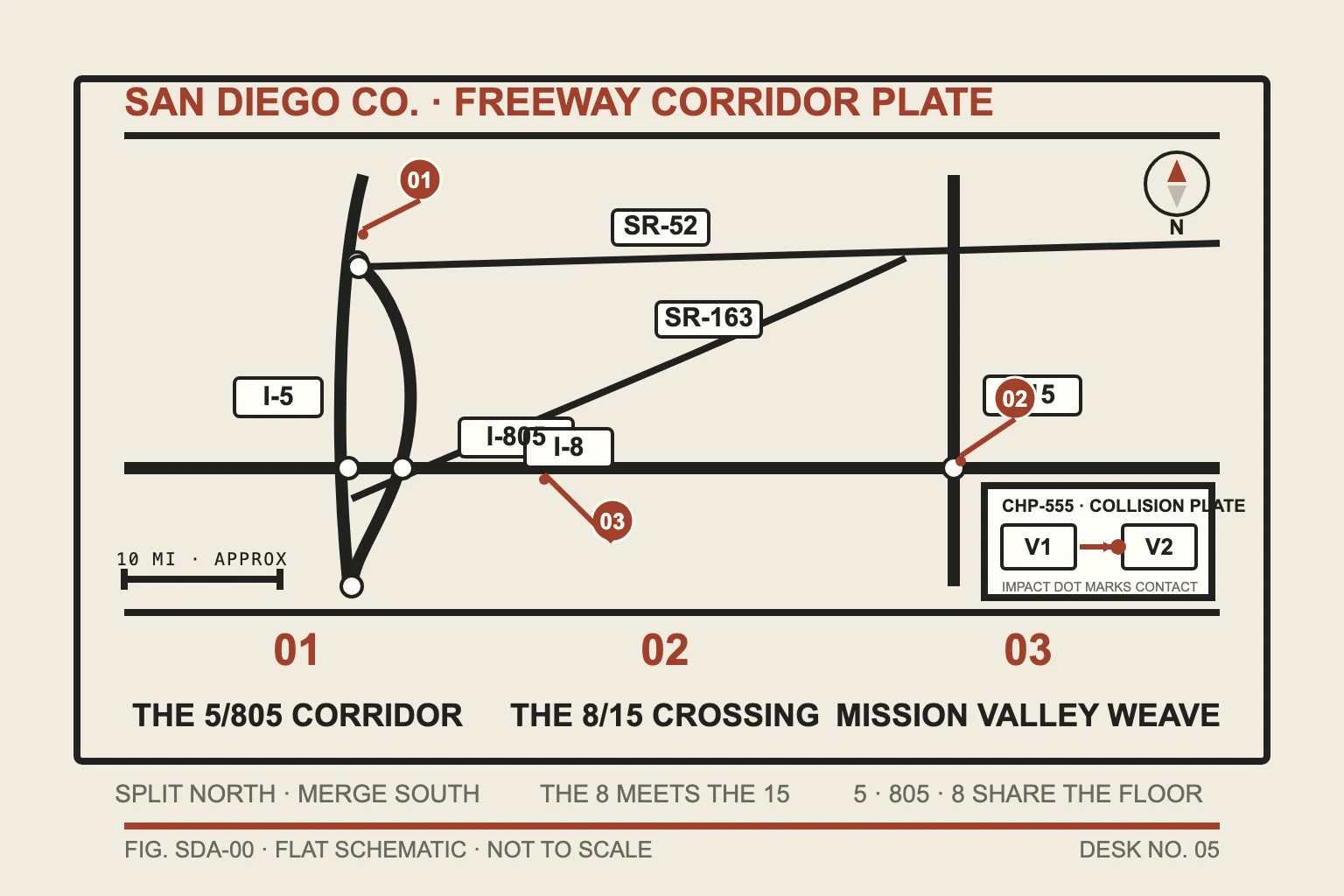
The 5/805 corridor
02The 8/15 crossing
03Mission Valley weave
Each carries its source. Every topic file expands on these.
California law makes stopping and exchanging information a duty after any collision — not a courtesy. Injury or death adds a duty to report to law enforcement (Vehicle Code §§20001–20004).
A collision with injury, death, or property damage over $1,000 means a written SR-1 report to the DMV within 10 days — whether or not police responded (Vehicle Code §16000).
For policies issued or renewed on or after January 1, 2025, California's minimum liability limits are $30,000 per person, $60,000 per accident, and $15,000 property damage (SB 1107; Vehicle Code §16056).
A personal-injury lawsuit must generally be filed within two years of the injury (Code of Civil Procedure §335.1). Narrow exceptions exist; applying one to a specific case is a lawyer's job.
Photographs are documents.San Diego Car Accident Desk — Crash documentation file
Every later decision — by an insurer, an adjuster, or a court — is made from records created in the days after a collision. Crash, medical, loss, and statement records, kept together, are what carry an injury from reported to documented.
Open the documentation file →Safety first, then evidence: exchange information, photograph everything before it moves.
Written report to the DMV after injury, death, or damage over $1,000.
Medical evaluations as symptoms dictate, records kept week by week.
Two years from the injury for a personal-injury lawsuit (CCP §335.1).
The SR-1 report is due within 10 days (Vehicle Code §16000); the scene duties run from day zero (Vehicle Code §§20001–20003); and a personal-injury lawsuit generally must be filed within two years of the injury (Code of Civil Procedure §335.1). Get fact-specific advice early.
Read the timeline file →Every file distinguishes medical information from California legal and insurance guidance. The desk grounds itself in the statutes (leginfo), DMV and CHP guidance, NHTSA crash research, and the local agencies — SDPD, the San Diego Superior Court, Caltrans — so readers can move from a plain-language explanation to the underlying authority.